Quickie Version
UTAD to start; lit stand-up targets or more UTAD once you have most numbers.
Go-To Flipper
Balanced
Full Rules
Two main goals: collect 14 of the 15 numbers, omitting one of the 1-5 or 9-15, then shoot lit targets (worth 300 vs. 50 unlit); and get the bumper lit for 100 points and hit it as often as possible.
You can’t shoot any of the number targets directly, you have to get them via slingshot hits, kicks off of the bumper, or bank shots. Just put the ball up top and let the slings and bumpers do the work, with nudging assist from you.
You light the bumper by making the 6, 7 and 8 lanes at the top. Find the Skill Shot for each top lane. Ideally, plunge the 6 first, soft plunge the 8 on the next ball, and get the 7 last to get the sure 100 points when the ball hits the now-lit bumper after going through it. If and only if the game has strong flippers, you can instead plunge for the 7 lane first. Why? You’ll find that bank shots to the top of the game off of the side stand-up targets will sometimes go back up through one of the top lanes. This happens far more often for the 6 and 8 lanes than for the 7 lane. If it does go through to the very top, try to nudge the ball into any other lane you don’t already have when it comes back down. But it does mean that it’s possible to get the bumper lit on the first ball, which is a huge scoring advantage on this game.
Collecting numbers “sort of” increases the number of lit arrow stand-ups, but it’s not one-to-one: yes, there are 15 numbers and 15 arrow targets, but how many and which one(s) are lit move with switch hits. You can have two numbers and two lit or ten numbers and none lit, but in general, more numbers translate to more lit targets. Now, why complete all but 1 (\!) of the numbers 1-15 around the sides of the game? Because if you get them ALL, the inlanes and outlanes change value from 100 points to Special. In tournament play, the Special is worth Zero. If you do get them all, there’s no way to un-do it.
Ball control: the inlanes usually will feed the ball down fast enough to transfer it to the other flipper; do so if there are lit arrows you can shoot from the other side but not from the return lane side. Likewise, use dead bounces and catches to get the ball to the shoot-lit side.
In general, shoot the ball up top all the time and don’t bother to shoot the arrows on the center bank unless they’re lit. Going topside gives you a chance to light the bumper if it’s not lit, to hit it if it is, and to collect more numbers to light more arrows.
Drain shots: The stand-up targets on the right and left ends of the center bank. The ONLY time you should ever shoot one of these is if all three of these are true:
1. it’s lit for 300
2. you’re the final player
3. you need less than 300 points to win
The center bank’s center target can be drainy, so don’t shoot it even if lit. The other center bank targets tend to be fairly safe, but again, don’t shoot for one unless it’s lit for 300.
Nudging: You want to nudge up top at times to get the ball to hit the upper slings hard enough to get a good kick off of them and score number targets; this calls for a push nudge. You want to do side nudges up top as the ball is approaching the top-bottom divider necks [edges of the slings above and center target bank below] to get the ball to come down from the top along the face of the lower slingshots*.* The most common drains on the game, besides those two targets I warned you about, are rolling down the sides directly from the upper playfield, slingshot cross-drains on the lower playfield, and soft downward bounces off of the arrow targets near the neck that go down the middle. When you see that the ball is coming down and is either going to hit one of these targets or hit a slingshot too softly to trigger it and then roll into one of the arrow stand-ups, try to gauge the angle of attack. You want the ball to bounce off the arrow target and go parallel to the lower slingshot close enough to it so that the ball rolls down its face to the flipper without triggering the slingshot.
Playfield Risk
It’s all about how balls exit the top at the sides of the triangle. Slow or vertically-angled balls can outlane drain; sharp bounces off of the arrow targets can center drain or go into the slingshots. Try to anticipate the ball’s path and nudge or not accordingly. See drain shot and nudging notes below for details.
External Links
Machine Information
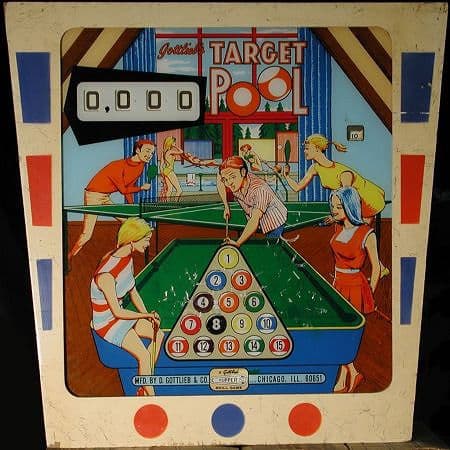
- Name
- Target Pool
- Manufacturer
- Gottlieb
- Year
- 1969
- Type
- em
- Display
- reels
- Players
- 1